
Quick answer
Skills development is the ongoing process of identifying the gap between an employee’s current abilities and the abilities a role requires, then closing that gap through practice, training, or experience. It covers both hard skills, which are technical and specific to a job, and soft skills, which are personal traits like communication or adaptability. Companies that invest in it see better talent attraction, retention, and productivity.

Skills development can sound like a broad idea. The research on the topic uses several categories: hard skills, soft skills, even personal or job-specific skills.
Whatever the scope you have in mind, skills development is a conversation every organization is having more than ever. According to LinkedIn’s latest Workplace Learning Report, “a people-centric culture recognizes that organizational success depends on individual success.”
What helps drive that success? Skills development is the answer. The same report states that 25% of the skill sets demanded at work have changed since 2015, and “that number is expected to double by 2027.”
So where do you start? In this article, we’ll walk through the definitions and give you real examples of the skills you should help your team develop.
What you’ll learn in this article
- What skills development means and why it matters
the definition behind the term, and why closing the skills gap is urgent in Latin America and beyond. - The four types of skills, per the World Bank
cognitive, socio-emotional, technical, and digital skills, with what each one covers. - Hard skills vs. soft skills
the real difference between the two, with concrete examples of each. - Seven soft skills worth developing in your team
from communication to work ethic, with what each one looks like in practice. - The benefits and the methods that actually work
five measurable benefits, plus the training methods companies use to close the gap.
By the end of this article: you’ll be able to tell hard skills apart from soft skills, name the type of skill gap your team has, and pick a training method to close it.
Reading time: 9 minutes | Level: beginner | For: managers, HR teams, and anyone planning a team’s training
What does skills development mean?
If you look up the dictionary definition of “skill”, you’ll find it described as “the ability to use one’s knowledge effectively and readily in execution or performance,” or “a learned power of doing something competently.”
Add the word “development” to that, and skills development becomes the ongoing practice of essential abilities for personal and professional life. Those abilities can be physical or mental.
Personal Excellence defines skills development as:
“The process that identifies the gaps in a person. Secondly, it means developing and perfecting these skills, to build the ability to execute their plans successfully.”
Personal Excellence
In short, skills development “covers the knowledge, competencies, and abilities needed to perform operational tasks.” Skills are built through life and work experience, and of course, they can also be learned through study or training.
What is a skill gap?
Whenever someone needs to strengthen or improve their skills, it’s because a skill gap exists. A skill gap is defined as the “difference between an employee’s skills and the skills their company requires for a specific role.”
Closing that gap helps a company structure training programs that support employees’ skills development.
Closing the skills gap is an urgent task. According to a report on the future of work in Latin America and the Caribbean from the Inter-American Development Bank, Latin America has the widest skills gap in the world.
“In fact, ManpowerGroup’s talent survey found that nearly 40% of organizations in Latin America report trouble filling their open roles. Close to 70% say they can’t find the right candidates to fill those positions,” the report states.
Ninja Summary
- Skills development closes the gap between what an employee can do and what their role requires.
- Latin America has the widest skills gap in the world, according to the IDB.
- Nearly 70% of companies in the region can’t find candidates with the right skills.
What are the types of skills development?
According to the World Bank, skills development falls into four types:
- Cognitive: the ability to understand complex ideas, adapt effectively to the environment, learn from experience, and reason.
- Socio-emotional: skills developed to manage interpersonal and social situations. This group covers leadership, teamwork, self-control, and determination.
- Technical: the knowledge and experience learned and gained to complete a task, including mastering tools or technologies.
- Digital: the World Bank treats this as a complement to the other three. It “describes the ability to access, manage, understand, integrate, communicate, evaluate, and create information safely and appropriately.”
Still, the most common way to sort skills is the hard skills vs. soft skills split. Heard the terms but never quite understood the difference? You’re in the right place. Let’s break it down.
Hard skills
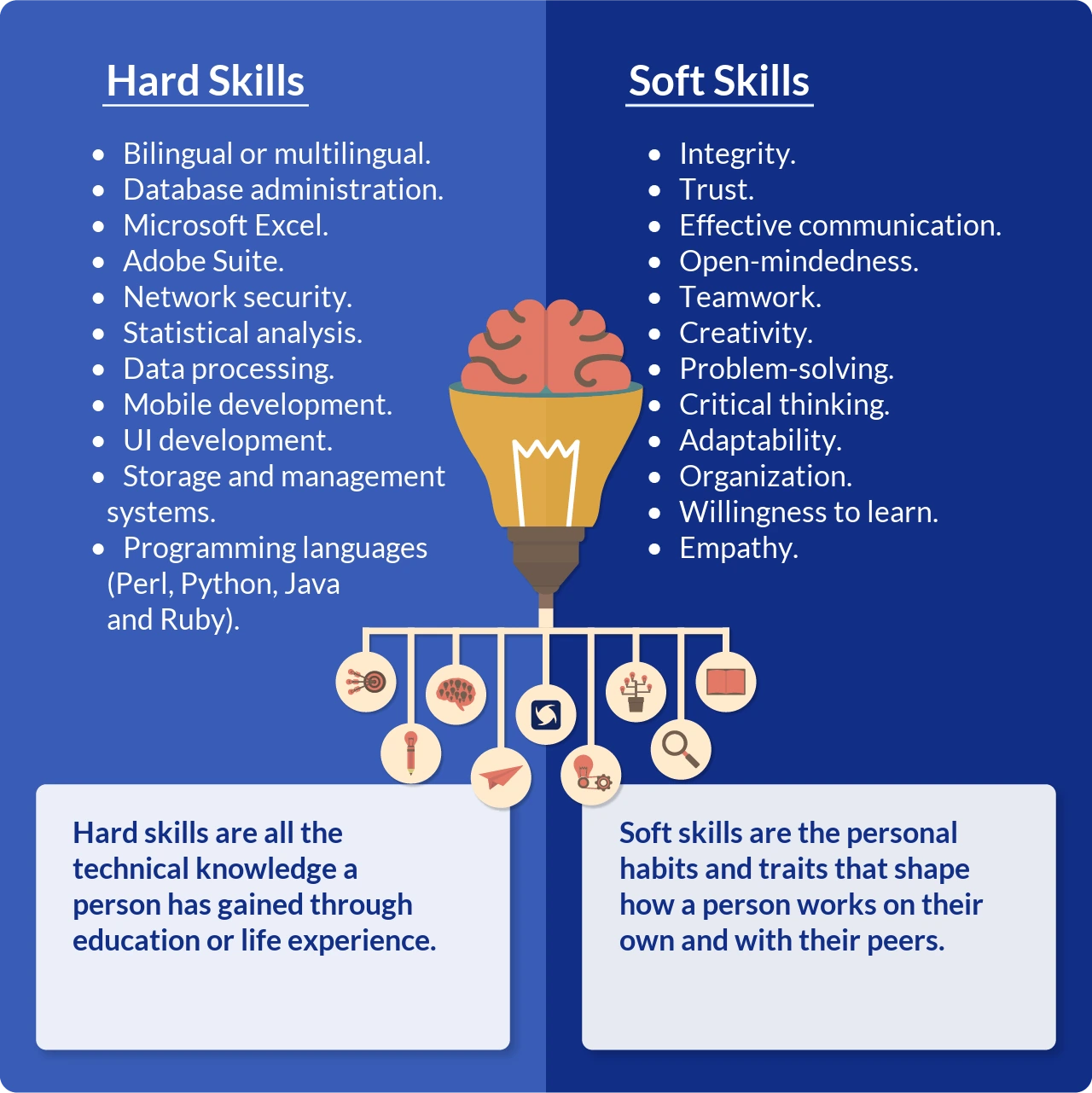
Hard skills, also known as technical skills, are the technical knowledge a person acquires through study, training, self-learning, and life experience. A few examples:
- Working at a supermarket or retail store usually means knowing how to operate a register.
- If you studied Spanish and earned a B2 certificate, you can hold a conversation in it with confidence.
- Taking a basic accounting course probably gave you working knowledge of Microsoft Excel.

Soft skills
A soft skill, on the other hand, is a personal trait that lifts a job or task to its highest level. Effective communication, for example, is a key soft skill companies look for. Indeed also includes reliability, effective teamwork, and active listening on the list.
A big difference from hard skills, which are specific and teachable, is that soft skills are harder to measure. Even so, they’re just as important for professional success as they are for better personal relationships.
What are examples of soft skills to develop?
There’s a long list of skills you can strengthen. Hard skills are harder to pin down, since they depend on the role, area of expertise, and the employee’s background, but soft skills are universal. Anyone can learn to identify and build them.
Here are a few examples of skills worth watching for and improving in your team. Let’s go through them:
- Communication: the ability to speak, write, and listen effectively.
- Interpersonal skills: the verbal and non-verbal behaviors and reactions in someone’s interactions with others.
- Organization: this includes keeping physical and digital spaces in order, and it also builds the ability to plan, schedule, and prioritize.
- Problem-solving: the ability to handle challenging or unexpected situations.
- Adaptability: the ability to adjust quickly and easily to new things. It matters most for people starting a new job.
- Integrity: per Indeed, integrity “means doing the right thing and telling the truth, even if it’s controversial or opens up new challenges.”
- Work ethic: this covers traits like reliability, accountability, quality, determination, and discipline.
Ninja Tip
Don’t try to build all seven soft skills at once. Pick the one that’s costing your team the most right now, measure it with a simple before-and-after check (a self-assessment, a manager review, a short survey), and work on just that one for a quarter. Trying to improve everything at the same time usually means nothing really improves.
What are the benefits of improving skills development?
Improving skills development in your team brings a number of real benefits. Here are the most important ones, based on information from SelectHub.
1. Talent attraction
Motivated, engaged people want access to learning opportunities. A company with consistent training policies or plans signals a positive work environment, which helps attract talent.
2. Employee development
Skills development can increase employee retention. By boosting development, it encourages employees to take on new roles and responsibilities with added capabilities.
3. Succession planning
Investing in today’s employees means building tomorrow’s leaders. By putting time and resources into personal and professional growth, managers and decision-makers can promote the people who contribute the most to the company.
4. Engagement
Professional growth keeps people motivated. Good training practices let companies compete, innovate, improve the products or services they offer, and reach their goals.
5. Performance and productivity
Talent is any organization’s biggest asset. Training opportunities support better employee retention, and that feeds overall productivity.

Ninja Summary
- Hard skills are technical and job-specific; soft skills are personal and harder to measure.
- Soft skills are universal: anyone can identify and build them, regardless of their role.
- Training that improves skills development drives attraction, retention, succession planning, engagement, and productivity.
How can a company boost skills development?
To successfully boost skills development among employees, a company needs more than a list of the skills it wants to build. It needs the most effective and efficient way to build them. There are several methods companies use:
- Group discussion and activities.
- In-person training with an instructor on-site.
- E-learning.
- Training by observation.
- Hands-on training.
- Coaching or mentoring.
- On-the-job training.
- Role-playing.
- Social learning.
- Case studies or other required readings.
- Video-based training.
- Simulation-based training.
Knowing how to identify the right method for your organization’s specific needs is a key step toward closing the skills gap. That way, you can move forward steadily in developing your team.
Take the next step in your team’s skills development
Start by measuring where your team stands today
Before picking a training method, it helps to know exactly where the gap is. A quick, structured assessment shows you which hard skills and soft skills your team already has, and which ones need work, so you invest your training budget where it actually moves the needle.
Not sure where your team’s skills gap really is?
Ninja Excel’s free Excel Skills Assessment shows you each person’s real level in minutes, inside Excel itself, so you stop guessing and start training where it counts.
Take the free Excel Skills Assessment
Takes a few minutes, no credit card required.
FAQ
What is the difference between skills development and training?
Training is one activity. Skills development is the ongoing process that training feeds into. A single course is training; building and tracking a skill over months, through practice and feedback, is skills development.
Are hard skills more important than soft skills?
Neither is more important on its own. Hard skills get the technical work done; soft skills determine how well someone works with a team and adapts when the job changes. Most roles need a mix of both.
How do I identify my team’s skill gap?
Compare the skills a role actually requires against the skills each employee currently has. A short self-assessment, a manager review, or a structured diagnostic (like Ninja Excel’s free Excel Skills Assessment for spreadsheet skills) all work to surface the gap.
Is Microsoft Excel a hard skill or a soft skill?
Excel is a hard skill. It’s a specific, teachable, technical ability that can be measured and certified, unlike a soft skill such as communication or adaptability.
How long does it take to develop a new skill at work?
It depends on the skill and how often it’s practiced. A focused technical skill, like a specific Excel function, can show real progress in a few weeks of regular use. Broader soft skills, like leadership, usually take months of consistent practice and feedback.
What are the four types of skills development, according to the World Bank?
Cognitive, socio-emotional, technical, and digital. Cognitive covers reasoning and adapting to new information; socio-emotional covers leadership and teamwork; technical covers job-specific knowledge and tools; and digital covers the ability to safely access, manage, and create information.