


Quick answer
A preventive maintenance plan in Excel is a spreadsheet system that schedules routine checks before equipment breaks down, instead of repairing it after a failure. It lists every asset, how often each one needs attention, who owns the task, and KPIs like MTBF and MTTR. Building one takes seven steps: inventory your assets, set goals, run a criticality analysis, pick your KPIs, set priorities, assign owners, and review the plan on a regular basis.
A preventive maintenance plan keeps machinery running without surprises. It tracks every asset in one spreadsheet, so you can see what needs attention before it breaks.
Building an effective plan takes more than a list of equipment. You need an asset inventory, priorities, KPIs and clear goals behind every task.
In this Ninja Excel guide you’ll see the full step-by-step process, what your Excel tracker should include, and the KPIs that tell you whether the plan is actually working.
What you’ll learn in this article
- What a preventive maintenance plan is
the difference between preventive and corrective maintenance, and why it matters for your equipment. - What an Excel maintenance tracker should include
the fields every asset needs, from identification to spare parts. - The seven steps to build your plan
from the asset inventory to the review cycle that keeps it accurate. - How to run a criticality analysis
the formula that ranks which assets need attention first. - Which KPIs to track
OEE, PMP, MTBF and MTTR, with what each one tells you.
By the end of this article: you’ll know how to set up a preventive maintenance plan in Excel, which fields and KPIs to track, and how to keep it current.
Reading time: 9 minutes | Level: basic to intermediate | For: maintenance, operations and facilities teams that track equipment in Excel
What is a preventive maintenance plan?
A preventive maintenance plan is a set of scheduled, routine tasks built to prevent breakdowns in a company’s equipment. Those tasks range from lubrication and small adjustments to detailed technical inspections, all aimed at avoiding failures that could stop production.
Its main goals are:
- Increase asset reliability.
- Minimize unplanned downtime.
- Maximize operating cost efficiency.
Some examples: lubrication, adjusting chains or belts, and technical inspections recommended by the manufacturer.
Why build a preventive maintenance plan?
A preventive maintenance plan is key to keeping equipment productive and cutting operating costs. According to Fiix Software, a solid plan can cut downtime by up to 50%.
- Cost savings: according to MaintainX, facilities can cut overall maintenance costs by 12% to 18%, mostly by avoiding the unplanned repairs that tend to cost more.
- Longer equipment life: preventive maintenance keeps equipment running within its ideal parameters, which extends its useful life and reduces costly replacements.
- Better safety: preventing unexpected failures lowers the risk of workplace accidents and keeps equipment within safety regulations.
- Regulatory compliance: many industries require equipment to meet safety and maintenance standards. A preventive plan helps keep assets within what manufacturers recommend.
- Operational efficiency: less unplanned downtime and less reactive maintenance mean production runs without interruptions.
What should a maintenance tracker include in Excel?
A useful maintenance spreadsheet needs these fields for every asset:
- Asset identification: name, equipment type and location.
- Maintenance task description: the actions that need to happen.
- Inspection frequency: daily, weekly or monthly.
- Owner: the technician or team responsible for the task.
- Materials needed: spare parts, tools and consumables.
- Operating conditions: ideal parameters, like temperature or pressure.
- Maintenance history: past tasks, parts used and issues found.
- Legal or regulatory requirements: any applicable rule.
- Priority and criticality: how urgent the task is and how much it affects operations.
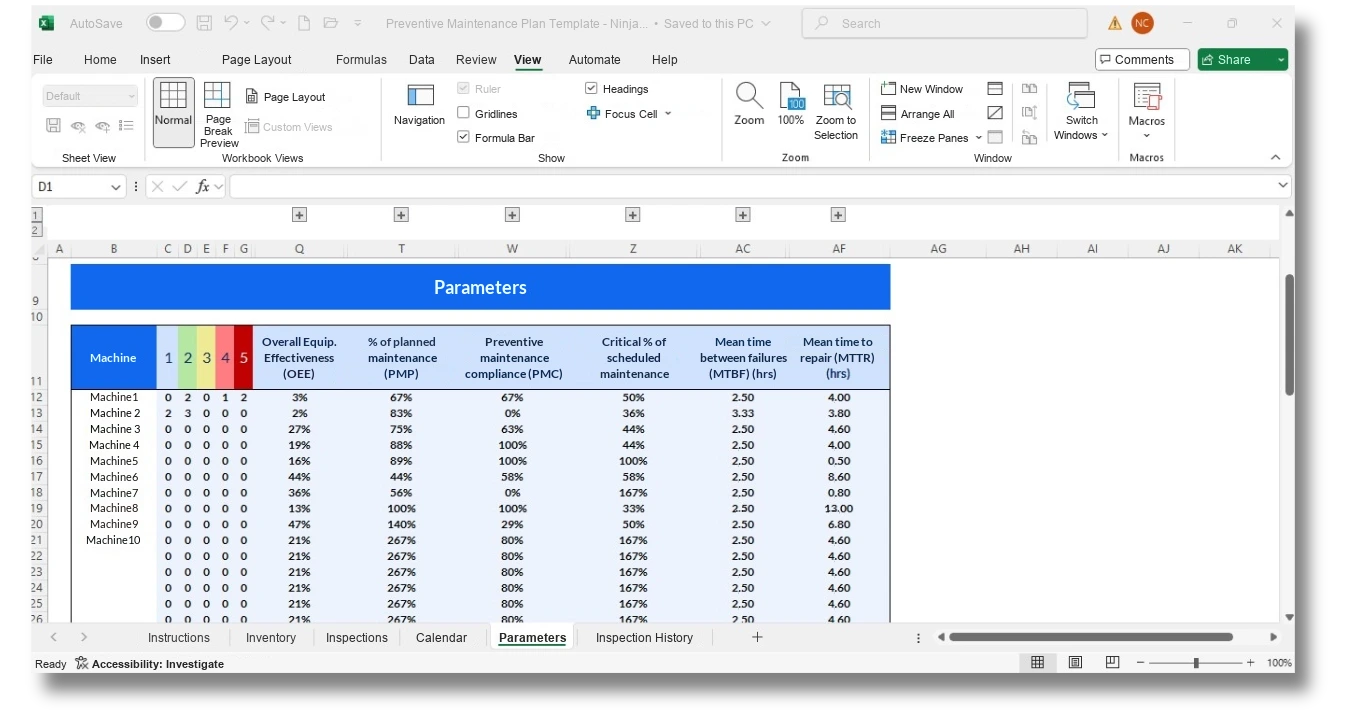
- KPIs: planned maintenance percentage, mean time between failures, and so on.
- Next review date: to plan and schedule future work.
A KPI tab keeps those numbers in one place, so you can compare machines at a glance:
Step by step to build a preventive maintenance plan
1. Build the asset inventory
An inventory gives you a clear record of what can be improved and where the opportunities are. What should you capture for each one?
- Brand, model and serial number.
- Warranty terms.
- Manufacturer recommendations for maintenance, like frequency, expected lifespan, and ideal temperature and humidity.
- Repair history.
- Asset criticality.
- Legal requirements.
2. Set goals and objectives
Decide what the plan is for. Are you trying to cut maintenance costs? Prevent failures that would hurt the business?
Some goal examples:
- Increase availability of critical equipment by 20% in six months.
- Cut unplanned downtime by 50% in a year.
- Reduce corrective maintenance costs by 15% in the first year.
- Reach 90% preventive maintenance compliance in the first quarter.

3. Run a criticality analysis
A criticality analysis is the key method for prioritizing maintenance tasks. Its goal is to find which assets have the biggest impact on operations and need the most urgent attention.
It looks at the frequency of failures and their consequence for productivity, safety, cost and quality:
Criticality = Frequency x Consequence
Consequence breaks down into:
- Operational impact: how a shutdown affects the overall workflow.
- Operational flexibility: how long you can tolerate the failure before it hurts operations.
- Maintenance cost: the expense of repairing or replacing the equipment if it fails.
4. Choose the KPIs to prioritize
Set specific, achievable targets. The most common KPIs for a preventive maintenance plan are:
- Planned Maintenance Percentage (PMP): the share of maintenance time spent on planned work versus unplanned work.
- Overall Equipment Effectiveness (OEE): a productivity measure for a piece of equipment, based on quality, performance and availability.
- Mean Time To Repair (MTTR): the average time it takes to fix a failed asset, including repair time, testing and the return to normal operation.
- Mean Time Between Failures (MTBF): the expected time between one breakdown and the next during normal operation.
- Preventive Maintenance Compliance (PMC): the percentage of scheduled preventive work completed within a given time frame.
Ninja Summary
- A preventive maintenance plan needs an inventory, clear goals, a criticality analysis and a set of KPIs.
- Criticality = Frequency x Consequence, and it’s what decides which assets go first.
- OEE, PMP, PMC, MTBF and MTTR are the five KPIs every maintenance tracker should follow.
5. Set priorities and assign resources
Once the data is in, assign each task to the right person. Set a priority (low, medium or high) and a due date, so the whole team stays aligned.
It also helps to check the equipment ahead of time. With that information, you can provide the right parts, materials, documents, tools and safety rules for the job.
Ninja Tip
Add a column with a days-until-due formula. If the next review date is in column D, use =D2-TODAY() and apply conditional formatting to turn it red when the result is zero or negative. That turns your spreadsheet into an early-warning system instead of a static log.
6. Assign owners and preventive maintenance actions
Define the resources, time, labor and other requirements for every preventive maintenance task. That lets you assign the right person quickly and keep maintenance on schedule, based on each technician’s skills and availability.
7. Review and improve the plan
Keep a maintenance checklist so you can track KPIs like the mean time to repair, the planned maintenance percentage and the mean time between failures on an ongoing basis.
Compare those numbers against the previous plan’s results. That comparison tells you how your program is affecting the efficiency of your maintenance operation.
Ninja Summary
- Set priorities, assign clear owners and review the plan on a fixed schedule.
- A maintenance checklist keeps every KPI visible instead of relying on memory.
- Compare each cycle against the previous one to see if the plan is actually working.
Conclusion
A preventive maintenance plan in Excel doesn’t need to be complicated. An asset inventory, clear goals, a criticality analysis and a handful of KPIs are enough to start catching problems before they become breakdowns.
Take the next step with Excel courses
Formulas and trackers like the ones in this guide become second nature with practice. Ninja Excel courses cover every skill level, with hands-on exercises inside Excel.
Still tracking maintenance on paper?
Formulas like the ones in this guide stick when you practice them inside a real spreadsheet. Ninja Excel courses walk you through building trackers like this one, with live classes and progress reports for team leads.
You start with a skills assessment, so you don’t repeat what you already know.
FAQ
What types of preventive maintenance are there?
There are two main types of preventive maintenance. Time-based maintenance runs on a fixed schedule and suits equipment that needs attention on a calendar. Meter-based maintenance triggers after a reading, like a set number of hours run, miles driven or production cycles completed.
What’s the difference between preventive and corrective maintenance?
Preventive maintenance is planned ahead of a failure, to avoid problems and extend equipment life, like regular lubrication or scheduled inspections. Corrective maintenance is reactive: it happens after equipment has already failed, and focuses on repairing it and restoring operation as fast as possible.
What are the main maintenance KPIs?
The five most common are OEE (Overall Equipment Effectiveness), PMP (Planned Maintenance Percentage), PMC (Preventive Maintenance Compliance), MTBF (Mean Time Between Failures) and MTTR (Mean Time To Repair). Track them in a dedicated tab so a formula like =AVERAGE(range) can summarize them per machine or per period.
How do you calculate OEE (Overall Equipment Effectiveness)?
OEE multiplies three factors: Availability x Performance x Quality. Availability compares running time against planned production time, performance compares actual output speed against the ideal speed, and quality is the share of good units out of total units produced. A result of 85% or higher is usually considered world class.
What is a maintenance checklist in Excel?
It’s a list of every action in your preventive maintenance plan, built so you can track each one as done or pending. A maintenance checklist is used to follow KPIs over time, like the mean time to repair, the planned maintenance percentage and the mean time between failures, instead of relying on memory.
Is Excel enough to run a preventive maintenance plan?
For a single site with a few dozen assets, yes. Excel handles the inventory, the schedule and the KPIs without extra cost. Once you manage hundreds of assets across several locations, need automatic alerts or want technicians to log work orders from a phone, a dedicated CMMS (computerized maintenance management system) becomes worth the investment.