
Career & Technical Education (CTE) Programs with Excel Certification: Built for Schools & Districts
Students work inside real spreadsheets, not video lectures. They finish with work they can show a college or an employer.
A transcript says a student showed up. It doesn't show what they can do.
Employers and admissions officers want proof of what a student can do. Grades alone do not show it.
Four abilities separate the people who advance at work: interpreting data, displaying it, communicating it, and acting on it. Students can learn all four in high school.
Ninja Excel teaches them in Excel, the tool they will use on the job.
-
More than 8 in 10 middle-skill jobs require digital skills
spreadsheet software is the single most requested.
Lightcast/Burning Glass, sponsored by Capital One
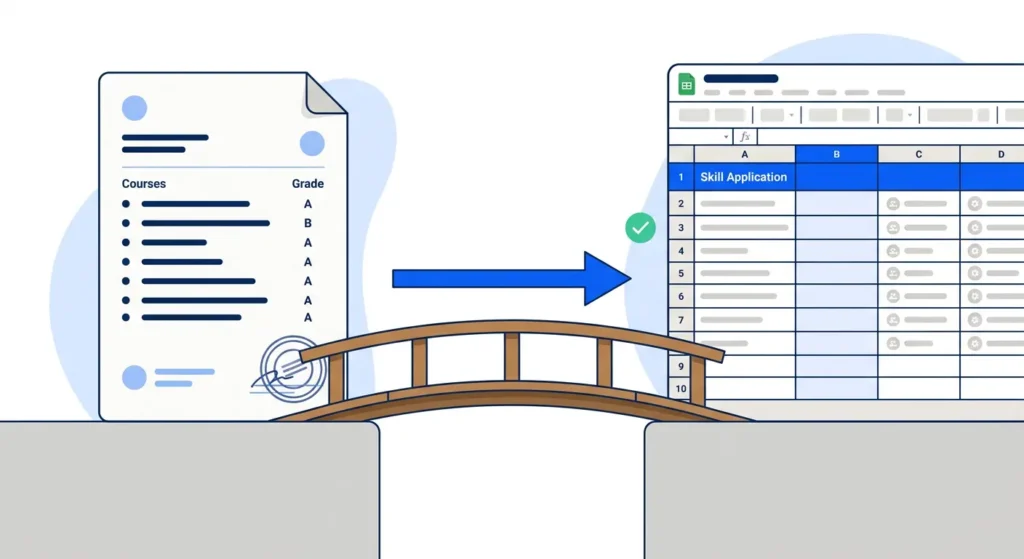
Learning by doing inside the spreadsheet.
Learn one skill at a time.
Use it right away in a live spreadsheet.
Find out what went wrong, immediately.
See the score before moving on.
Then it starts again with the next skill.
Schools are already running Ninja Excel
Cristo Rey Jesuit ran it with an entire freshman class. Here is what their assistant principal saw.
Featured case — Cristo Rey Jesuit High School
"One of our students wrote in his final essay about helping his father run his business — because now he knows Excel, he's able to help with the books. That's even better than him being a valuable worker when he goes off to a job this year. Our goal is to improve the lives of these families."
Jennifer Swanson, Assistant Principal, Cristo Rey Jesuit High School
113 freshmen started. In the first year, 33 reached C2, the top level of the framework.
Students work inside Excel, not around it.
Running now in US high schools.
Works in English and Spanish.
Already used in several countries.
Start free with YEL by Ninja
a turnkey project and national competition.

YEL by Ninja (Young Excel Learners) is a project you can run next week. Students get a messy dataset and a business question, then clean it, analyze it, and build something they can show. Students who want to go further enter the national competition. The project is free. One conversation gets you started.
1
Students get a messy dataset and questions in plain English.
2
Answering them takes actual Excel work: cleaning, lookups, PivotTables, a dashboard.
3
You grade it with the rubric we provide. About 10 minutes. You do not need to know Excel.
4
Students who want more submit a short video to the national competition.
What students walk away with
📊 Skills they can demonstrate.
Spreadsheet work they can open in an interview and walk an employer through, line by line.
📜 A Ninja Excel certification.
Our own proficiency levels, adapted from CEFR. It belongs on a resume, though it is not a state-approved credential.
🧭 A stronger CTE pathway.
Drops into Business or Entrepreneurship as a workplace-grade unit, without rebuilding the sequence you already had approved.
Built for the whole school, not just the classroom
CTE and Business programs.
A single unit you drop into a course you already teach, with an outcome you can report at the end.

Classroom teachers.
Dataset, brief and rubric provided. Grading takes about 10 min and you do not need to know Excel.

District administrators.
A dashboard of what students actually completed, and a line item your grants office can sign off on.


Fund it with Perkins.
Get paid back on certifications.
Ninja Excel is an allowable Perkins V expense, so the money is already sitting in your CTE budget. Students leave ready to certify, and in states like Florida and Texas those certifications come back to the district as funding.
- Allowable under Perkins V as curriculum, software and teacher PD
- Practice layer for the industry certification your district already gives
- Counts toward your 5S1 credential attainment rate
Funding rules vary by state and district. Ninja Excel is an allowable curriculum and professional development expense under Perkins V. It is not itself a state-approved credential. Your CTE director and grants office make the final call, and we will help you build the case.
Frequently Asked Questions
Earning a Excel certification is an industry-recognized way for high school students to validate their digital skills in a competitive labor market. These exams use a live-in-the-application testing methodology, meaning candidates perform real-world tasks directly within the spreadsheet software rather than answering multiple-choice questions. By passing these assessments which include Associate-level and advanced Expert-level credentials students prove they have true technical proficiency. For students, this certification moves beyond simply listing skills on a resume; it provides objective, third-party validation that enhances employability in data-dense fields and eases the transition to postsecondary education.
For schools looking to implement these credentials at scale, structured training programs like those offered by Ninja Excel help students build the practical Excel skills required before attempting the Microsoft Office Specialist (MOS) certification exam. Combining guided instruction, hands-on exercises, and certification preparation increases student confidence while helping schools improve credential attainment rates.
Career and Technical Education (CTE) is an organized educational framework that shifts instruction from traditional lectures to hands-on, career-connected experiences designed to develop academic knowledge, technical expertise, and employability skills. Funded primarily by the federal Strengthening Career and Technical Education for the 21st Century Act (Perkins V), CTE programs are organized into industry-aligned career clusters. In a major 2026 update, 21 states have integrated their Perkins V planning directly into combined Workforce Innovation and Opportunity Act (WIOA) state plans, representing a significant increase from just 9 states in 2024 and signaling a deeper alignment between education and employer priorities. CTE prepares students by providing instruction in state-of-the-art labs, incorporating work-based learning, and guiding them toward earning industry-recognized credentials.
Because CTE emphasizes applied learning, many schools complement their academic curriculum with industry-focused training providers. Programs such as Ninja Excel’s K–12 Excel curriculum support this approach by giving students project-based Excel experience aligned with workforce expectations and recognized certifications.
Under the Every Student Succeeds Act (ESSA), CCR is measured through multi-faceted accountability frameworks that look beyond traditional standardized test scores. According to a 2025 fifty-state analysis, 42 states now incorporate at least one CCR indicator into their federal or state school performance metrics. States are increasingly weighting these indicators heavily; for example, Louisiana launched its “Grow. Achieve. Thrive.” accountability formula in the 2025–26 school year, introducing a “Thrive” pillar worth 25% of a high school’s performance score based on benchmarks like a 20 on the ACT, a 1040 on the SAT, or a Gold on ACT WorkKeys. College readiness is generally measured through AP/IB exam performance, dual credit completion, and ACT/SAT scores. Career readiness is measured by practical labor-market metrics, such as completing a CTE program sequence, participating in work-based learning, or earning recognized industry credentials.
Building measurable digital skills is becoming an increasingly important component of career readiness. By helping students earn Microsoft Excel certifications and develop workplace-ready spreadsheet skills, schools can strengthen the practical outcomes that many CCR frameworks seek to promote. Programs like Ninja Excel are designed to support these objectives through structured, real-world Excel training.
Yes, Microsoft Excel certification is a highly eligible expense under Perkins V, provided it is integrated into a state-approved CTE program of study that aligns with high-wage and in-demand industries. Federal regulations allow Perkins funds to support the purchase of curriculum, practice tests, and exam vouchers that lead to recognized credentials of value. States frequently tier their funding based on the economic return of the credential; for instance, under Iowa’s 2026–2027 Credentials to Careers Grant program, schools can receive up to $50,000 for “Tier 3” credentials that align with high-skill, high-wage, and high-demand (H3) occupations. However, local school districts must always justify these expenditures through a Comprehensive Local Needs Assessment (CLNA) conducted every two years.
Many school districts work with specialized education partners to implement Perkins-funded certification initiatives. When aligned with an approved CTE pathway, training providers like Ninja Excel can support curriculum delivery, exam preparation, and student readiness while helping schools maximize the value of their Perkins investment.
A standard business class is generally a standalone elective that introduces basic business concepts without a mandate to achieve industry credentials or vertical alignment to higher education. In contrast, an approved CTE program of study is a formalized, non-duplicative sequence of at least two or three courses that integrates academic knowledge with technical skills. CTE pathways are guided by structured business advisory boards, incorporate work-based learning opportunities, and explicitly culminate in industry-recognized credentials. Because they must meet specific standards for size, scope, and quality, CTE programs are eligible for federal Perkins V and specialized state-restricted funding, whereas standard business electives are typically funded by general education budgets. To bridge classroom learning with industry expectations, many schools supplement traditional instruction with certification-focused training. Ninja Excel’s programs are designed to provide students with practical Excel experience that aligns with CTE goals, workforce readiness, and Microsoft certification pathways.
Real Excel. The platform streams Microsoft Excel into the browser, so students enter formulas, reference cells and check results in a live spreadsheet.
The distinction matters in a CTE pathway. A student who only clicked through a simulation freezes the first time they open a real workbook. A student who spent the semester inside Excel does not. The skill transfers to whatever the employer uses, because it is the same software.
An up-to-date browser (Chrome, Firefox or Edge) and an internet connection. Nothing to install, nothing to download, and students do not need Excel on the device or a Microsoft account.
That means it runs on the Chromebooks most districts already have, and IT review goes quickly because there is no software to approve or push to devices.
No. Every exercise uses a workbook Ninja Excel provides, with the dataset and validation rules already built in. Students never upload a file of their own.
For your district that means the platform does not touch student-created documents or anything on your network, which narrows what your data privacy review has to cover.
Help your students learn the
skills that shape their future
Let’s explore how Ninja Excel can support your school’s learning goals.